


What Causes Pump Vibration to Reach Connected Piping?
Rotating equipment can transmit vibration through nozzles and connected piping. Alignment, balance, supports, anchors, guides, operating condition, and system geometry all affect the result.
- Identify the vibration source
- Review equipment and piping supports
- Follow equipment-manufacturer and system-designer requirements
How Corrugated Hose and Braid Work Together
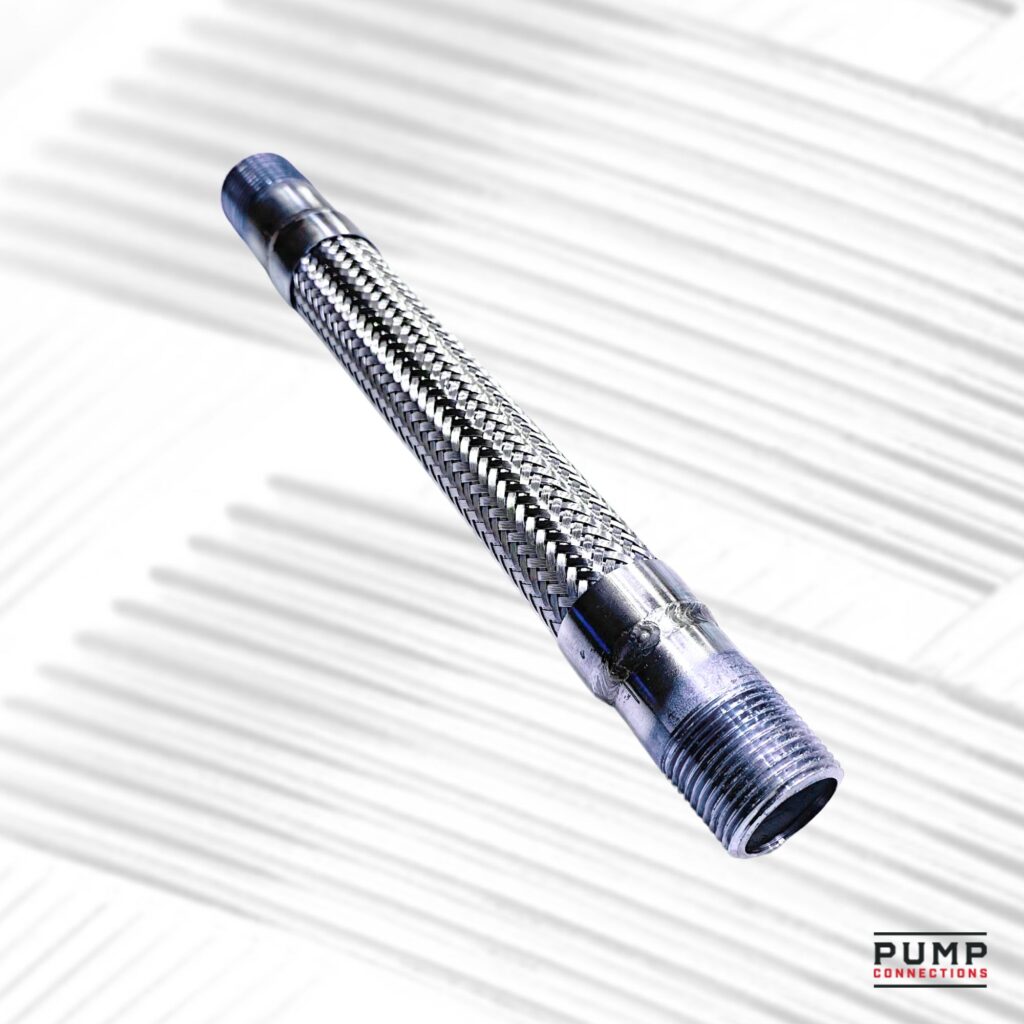
Corrugated hose provides flexibility. External braid supports the hose under internal pressure and restrains pressure thrust, subject to the design of the complete assembly.
- Hose and braid perform different functions
- The complete assembly determines suitability
- No universal pressure rating should be inferred
Vibration Is Different from Misalignment and Thermal Movement
Vibration, installation offset, and thermal movement are different inputs. A connector should not be used to conceal poor alignment or replace required piping design elements.
- Avoid torsion and forced installation
- Identify movement direction and magnitude
- Retain required anchors, guides, and supports
What to Verify Before Selecting a Pump Connector
Confirm the assembly and operating environment before purchase.
- Media, pressure, and temperature
- Nominal size, connection type, material, and overall length
- Movement, vibration, installation geometry, and quantity
Installation Questions to Review with the System Designer
Confirm orientation, bend geometry, support, mating connections, equipment instructions, and whether the proposed assembly is appropriate for the actual motion.
- Is the assembly installed without twist?
- Are mating connections aligned and supported?
- Are inspection and replacement access adequate?
Specification checklist
What to Verify Before Selecting a Pump Connector
Buyer questions
Pump Vibration Connector FAQs
Will a flexible pump connector eliminate vibration?
No. A properly selected connector may help reduce transmitted vibration, but overall performance depends on the equipment, piping design, alignment, supports, anchors, guides, and installation.
Can flexible hose correct piping misalignment?
It should not be used to conceal improper alignment. Have the piping and equipment connections aligned according to the approved design.
What details are needed for selection?
Provide media, pressure, temperature, size, end connections, material, overall length, movement, vibration, and installation geometry.
Where can I compare available connector styles?
Use the product catalog and threaded, flanged, stainless-steel, carbon-steel, HVAC, and industrial category pages.
Ready to compare connector configurations?
Match the connection, material, size, length, and service conditions to the approved system requirements.